LiteBlue USPS Virtual Timecard Login 2026: Complete Employee Guide
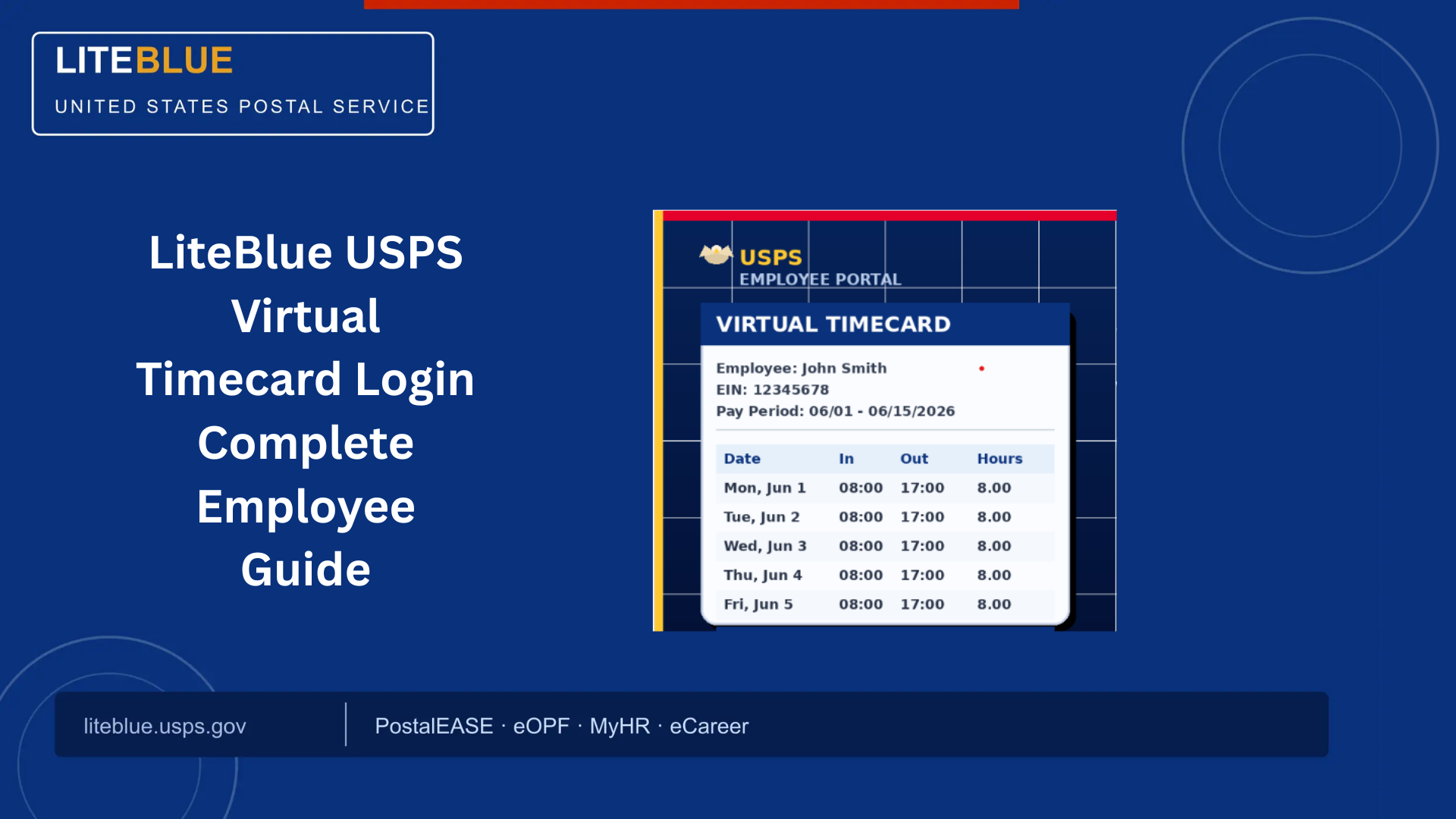
The LiteBlue USPS Virtual Timecard is a secure online tool inside the LiteBlue employee portal (liteblue.usps.gov) that lets USPS employees view their clock-in/clock-out times, overtime hours, and pay period data in near real-time updated every 5–10 minutes without paper timesheets or manual tracking.
To access it:
- Go to liteblue.usps.gov
- Log in with your Employee ID and password
- Navigate to Employee Apps > Virtual Timecard
What Is LiteBlue USPS?
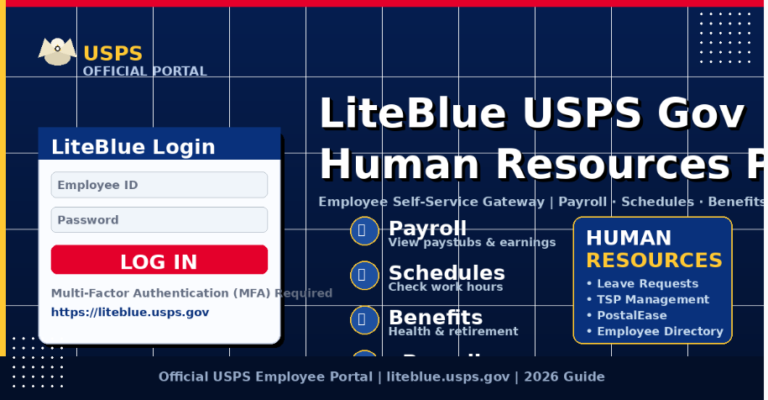
LiteBlue is the official intranet and self-service portal for United States Postal Service (USPS) employees. It is hosted at liteblue.usps.gov and serves as the central hub for all employee-facing tools, including:
- PostalEASE – benefits enrollment and management
- ePayroll – digital pay stubs and paycheck history
- Virtual Timecard – real-time clock ring tracking
- eOPF – electronic Official Personnel Folder
- USPS Blue – internal news and announcements
- HERO – housing and employee resource support
Every USPS career employee from city carriers to postmasters has access to LiteBlue using their Employee ID and password. The portal is available 24/7 from any internet-connected device.
Official Source: Always access LiteBlue through the verified URL: https://liteblue.usps.gov never through third-party links or search ads.
What Is the Virtual Timecard?
The LiteBlue USPS Virtual Timecard is an electronic timekeeping display integrated into the LiteBlue portal. It pulls data directly from the USPS Time and Attendance Collection System (TACS) the same system supervisors and payroll departments use.
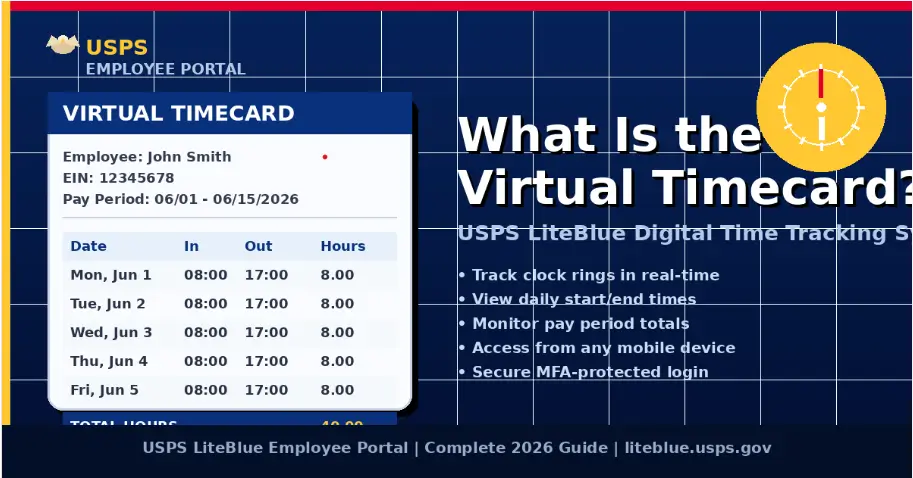
In simple terms, it shows you:
- When you clocked in and out each day
- Total hours worked per day and per pay period
- Overtime and penalty overtime hours
- Leave usage (annual, sick, LWOP, etc.)
- Move codes and route types
Before the Virtual Timecard existed, employees had to rely on paper timesheets, ask supervisors for their hours, or wait until ePayroll was released to check their pay. That process was slow, error-prone, and frustrating especially when overtime disputes arose.
Today, the Virtual Timecard solves that entirely. You can check your hours within minutes of clocking out.
How to Access LiteBlue USPS Virtual Timecard Login
To access the Virtual Timecard, you must first successfully log into the LiteBlue portal. Here is everything you need:
What You Need Before You Log In
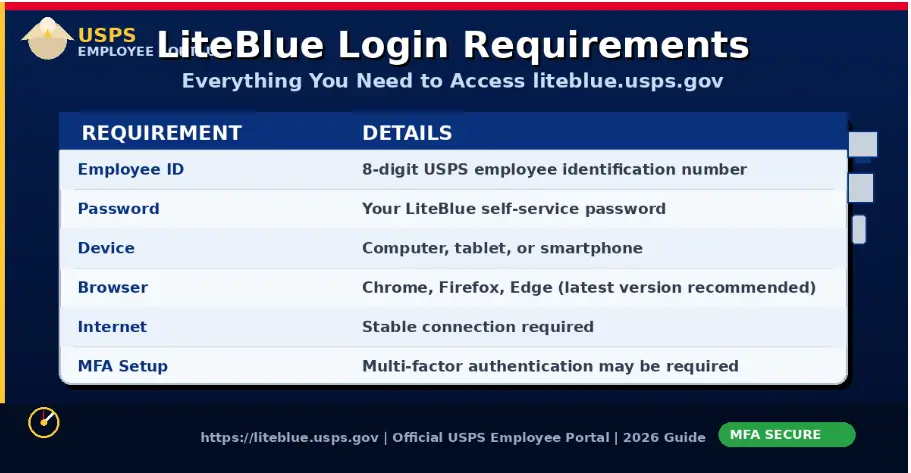
Important: Your Employee ID is printed on your pay stub, USPS ID badge, and ePayroll statements. It is NOT the same as your EIN.
Step-by-Step Login Guide
Follow these steps to access your Virtual Timecard in 2026:
Step 1: Open Your Browser and Go to LiteBlue
Type https://liteblue.usps.gov directly into your browser address bar. Do not click on sponsored ads in search results always use the direct URL.
Step 2: Enter Your Employee ID
On the LiteBlue homepage, enter your 8-digit Employee ID in the first field. Do not add spaces or dashes.
Step 3: Enter Your Password
Type your LiteBlue self-service password in the password field. Passwords are case-sensitive.
If you have forgotten your password, click “Forgot Password” and follow the self-service password reset flow using your Employee ID and registered email or phone number.
Step 4: Complete Multi-Factor Authentication (If Prompted)
As of 2025–2026, USPS has strengthened LiteBlue security with MFA. You may receive:
- A one-time code via text message
- A code via email
- A prompt from an authenticator app
Enter the code within the time limit to proceed.
Step 5: Navigate to Employee Apps
Once logged in, look for the “Employee Apps” section on your LiteBlue dashboard. This is typically displayed as a set of icons or a dropdown menu.
Step 6: Click on Virtual Timecard
Under Employee Apps (or under the Timekeeping section depending on your portal layout), click on “Virtual Timecard.”
Step 7: Select Your Pay Period
By default, the current pay period will load. You can toggle between pay periods using the navigation arrows or dropdown at the top of the timecard screen.
Step 8: Review Your Clock Rings
Your daily clock-in and clock-out records will display in a table format. Review each entry carefully.
Key Features of the Virtual Timecard
The LiteBlue USPS Virtual Timecard is packed with practical features designed to keep employees informed and protected:
1. Real-Time Clock Ring Display
Every time you badge in or out at your facility, the data is captured by TACS and reflected in your Virtual Timecard within 5 to 10 minutes. This near-instant visibility means you no longer have to guess whether your clock ring registered correctly.
2. Daily and Pay Period Totals
The timecard automatically calculates:
- Daily total hours
- Pay period total hours
- Regular time vs. overtime breakdown
- Leave taken (annual, sick, FMLA-related)
3. Move Code and Operation Tracking
For craft employees like letter carriers and clerks, the timecard may also display move codes that indicate which operations or routes your hours were charged to. This is useful for understanding how your time was allocated across different job functions.
4. Multi-Device Accessibility
Whether you are at home on a laptop or checking your phone between routes, LiteBlue’s Virtual Timecard is mobile-responsive and works on all modern devices with internet access.
5. No Special Software Required
No app download or plugin installation needed. The Virtual Timecard runs entirely in your web browser.
6. Historical Pay Period Access
You can navigate back to prior pay periods to review historical hours. This is valuable when reconciling past paychecks or addressing a grievance.
How Often Is the Virtual Timecard Updated?
This is one of the most common questions USPS employees ask and the answer has some nuance.
| Factor | Impact on Update Speed |
|---|---|
| Standard update cycle | Every 5–10 minutes after a clock ring |
| USPS district | Some districts update faster than others |
| Network load at facility | High traffic periods may slow TACS sync |
| Supervisor override changes | May take longer to reflect (requires manual entry) |
| System maintenance windows | Updates pause during scheduled USPS IT maintenance |
Bottom line: Most clock rings appear within 5–15 minutes. If a clock ring has not appeared after 30+ minutes, contact your supervisor to verify whether your badge registered correctly at the physical timeclock.
How to Read Your Virtual Timecard
When you open your Virtual Timecard, you will see a grid that looks something like this:
| Date | Day | In | Out | Total Hours | Type |
|---|---|---|---|---|---|
| 06/02/2026 | Mon | 07:01 AM | 03:42 PM | 8:41 | Regular |
| 06/03/2026 | Tue | 07:00 AM | 05:15 PM | 10:15 | OT |
| 06/04/2026 | Wed | 07:02 AM | 03:30 PM | 8:28 | Regular |
Here is what each column means:
- Date / Day – The calendar date of that work shift
- In – Your clock-in time (when you badged in)
- Out – Your clock-out time (when you badged out)
- Total Hours – Auto-calculated hours for that shift
- Type – Classification of hours (Regular, Overtime, Annual Leave, Sick Leave, LWOP, etc.)
Pro tip: Cross-reference your Virtual Timecard daily total with your ePayroll pay stub when it is released each pay period. Any mismatch should be reported to your supervisor immediately.
Virtual Timecard vs. ePayroll vs. PostalEASE
Many employees confuse these three LiteBlue tools. Here is a clear breakdown:
| Tool | What It Shows | When to Use It |
|---|---|---|
| Virtual Timecard | Real-time clock rings, daily hours, pay period totals | Check hours daily; catch errors before payroll closes |
| ePayroll | Finalized pay stub, deductions, net pay | Review after each pay period closes |
| PostalEASE | Benefits enrollment, TSP contributions, allotments | Open Season, life events, allotment changes |
| eOPF | Official Personnel Folder, employment records | Review employment history, disciplinary records |
| HERO | Housing and financial assistance resources | Personal financial hardship needs |
Each tool serves a different purpose. The Virtual Timecard is your first line of defense against payroll errors it catches problems while there is still time to fix them.
Common Problems and How to Fix Them
Even a well-designed system has hiccups. Here are the most common Virtual Timecard issues USPS employees encounter and how to resolve them:
Problem 1: Cannot Find the Virtual Timecard in LiteBlue
Cause: The portal layout has changed, or you are looking in the wrong section.
Fix:
- Log in and look under “Employee Apps” or “Timekeeping”
- If still not visible, contact your local HR office or USPS Help Desk at 1-800-275-8777
- Some employees on temporary assignments may have limited portal access
Problem 2: Virtual Timecard Won’t Load or Shows a Blank Screen
Cause: Browser compatibility issues, cached data, or a USPS system outage.
Fix:
- Clear your browser cache and cookies
- Try a different browser (Chrome or Firefox work best)
- Disable VPN if you are using one
- Check for USPS system maintenance announcements on the internal bulletin board
Problem 3: Missing Clock Rings
Cause: Badge malfunction, clock machine error, or failure to badge in/out properly.
Fix:
- Report to your supervisor immediately — do not wait until payday
- Your supervisor can enter a manual “ring correction” in TACS
- Document the issue in writing (email or PS Form 1017-B) for your records
Problem 4: Incorrect Hours Shown
Cause: Wrong move codes entered by supervisor, system sync error, or unauthorized changes.
Fix:
- Bring the discrepancy to your supervisor’s attention in writing
- If not resolved within 24 hours, escalate to your station manager or HR
- NALC and APWU members can file a grievance if the issue affects pay
Problem 5: Login Failures or Account Lockout
Cause: Wrong password entered multiple times, expired password, or MFA failure.
Fix:
- Use the “Forgot Password” self-service reset option on the login page
- If locked out, call the USPS HR Shared Service Center: 1-877-477-3273
- Update your MFA phone number or email in advance to avoid lockouts
Best Practices for Using Your Virtual Timecard
Experienced USPS employees who use the Virtual Timecard effectively follow a consistent routine. Here are the habits that make a real difference:
Daily habits:
- Check your Virtual Timecard at the end of every shift not just on payday
- Look specifically at your clock-out time to confirm the ring registered
- Take a screenshot or photo if you spot anything irregular
Weekly habits:
- Review your week-to-date total every Saturday to catch overtime discrepancies
- Compare your hours against your assignment or schedule for that week
Each pay period:
- When your ePayroll stub drops, compare it line-by-line with your Virtual Timecard records
- File a correction request if any hours, leave, or overtime do not match
- Keep a personal log or spreadsheet of your hours as a backup
Account maintenance:
- Keep your MFA contact information up to date in LiteBlue settings
- Change your password periodically per USPS security policy
- Never share your Employee ID or password with anyone, including coworkers
Why the Virtual Timecard Matters for USPS Employees
USPS employees work long, unpredictable shifts often starting before dawn, running overtime without notice, and navigating complex scheduling rules under national agreements. The Virtual Timecard is not just a convenience tool. It is a financial protection tool.
Here is why it matters:
Catching overtime errors early. Under USPS pay rules and the National Agreement, overtime hours must be compensated at specific rates (straight overtime, penalty overtime, etc.). Errors in overtime coding can cost employees hundreds of dollars per pay period.
Supporting grievance filings. In the event of a payroll dispute, your Virtual Timecard data is admissible evidence. NALC stewards and APWU reps regularly use Virtual Timecard screenshots to support members’ pay claims.
Preventing “short checks.” A short check being paid less than you worked — is far easier to fix before payroll closes than after. The Virtual Timecard gives you a real-time view to catch these before it is too late.
Accountability for both parties. Supervisors who know employees are actively monitoring their Virtual Timecards tend to be more careful about entering accurate clock rings and move codes.
Peace of mind. Knowing your hours are being tracked accurately reduces work stress especially during heavy overtime seasons like peak holiday delivery and political election mail periods.
MFA and Account Security Tips
Starting in 2024 and continuing into 2026, USPS strengthened LiteBlue security with mandatory Multi-Factor Authentication (MFA). Here is what you need to know:
What Is MFA?
MFA (Multi-Factor Authentication) requires you to verify your identity with a second factor — usually a one-time code sent to your phone or email in addition to your password.
How to Set Up or Update Your MFA
- Log into LiteBlue
- Go to Account Settings or Profile & Security
- Navigate to Multi-Factor Authentication settings
- Add or update your phone number or email address
- Choose your preferred verification method
Critical: If you change your phone number and do not update it in LiteBlue first, you can be locked out of your account permanently until HR resets it manually. Update your MFA contact information before changing your phone number.
Security Best Practices
- Never log in on a public computer or unsecured public Wi-Fi
- Always log out completely when done do not just close the tab
- Do not click on phishing emails that claim to be from USPS or LiteBlue
- Report suspicious login attempts to the USPS Cybersecurity team
FAQs LiteBlue USPS Virtual Timecard Login
Conclusion
The LiteBlue USPS Virtual Timecard is one of the most practical and underused tools available to USPS employees. In a job where shifts run long, overtime is common, and payroll errors can cost you real money, having near-instant access to your clock ring data is not a luxury — it is a necessity.
Key takeaways from this guide:
- Access your Virtual Timecard at liteblue.usps.gov using your Employee ID and password
- The timecard updates every 5–10 minutes from USPS TACS
- Check your clock rings daily, not just on payday
- Compare your timecard to your ePayroll stub every pay period
- Report any discrepancies immediately and in writing to your supervisor
- Keep your MFA settings updated to avoid account lockouts
- Screenshot anything that looks wrong for your records
Make the Virtual Timecard a daily habit. A two-minute check at the end of your shift can save you hours of headache and hundreds of dollars down the road.
Editorial Policy
This article is produced following strict editorial standards aligned with Google’s E-E-A-T (Experience, Expertise, Authoritativeness, and Trustworthiness) guidelines. All factual claims are sourced from official USPS documentation or directly verified through liteblue.usps.gov. We do not accept payment for favorable coverage and maintain full editorial independence. If you identify outdated or inaccurate information, please contact us so we can review and update accordingly.
Content Transparency Statement
This content is intended solely for informational and educational purposes for USPS employees. It is not affiliated with, endorsed by, or officially connected to the United States Postal Service or the federal government. For official guidance on LiteBlue or USPS employee tools, always refer to liteblue.usps.gov or contact your local USPS HR office. This article was last reviewed and updated in June 2026.