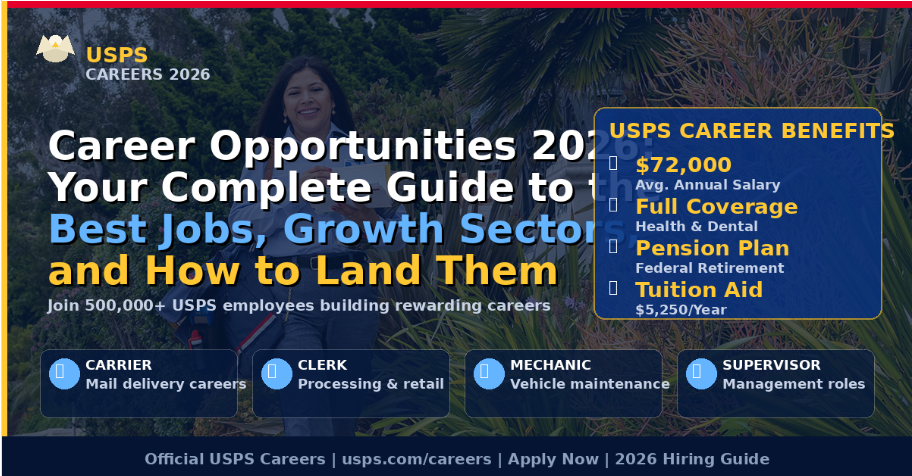
Career Opportunities 2026: Your Complete Guide to the Best Jobs, Growth Sectors, and How to Land Them
The top career opportunities in 2026 span technology, logistics, healthcare, finance, and government sectors. The U.S. Postal Service (USPS) alone offers 2,000+ job functions across delivery, IT, engineering, HR, legal, and more. In the broader job market, AI-related roles, cloud architecture, cybersecurity, data analytics, and supply chain management are among the fastest-growing fields. Whether you’re entering the workforce or switching careers, 2026 offers more diverse pathways than ever before.
Why 2026 Is a Pivotal Year for Career Growth
The job market in 2026 looks nothing like it did five years ago. Automation, AI integration, post-pandemic restructuring, and a renewed focus on public infrastructure have reshaped what employers need and what workers can expect.
Three major forces are driving career opportunities in 2026:
1. AI Augmentation, Not Replacement Most organizations are not eliminating jobs wholesale. Instead, they’re restructuring roles around AI tools. Workers who understand how to use AI as a productivity layer in finance, HR, logistics, or IT are among the most sought-after candidates.
2. Public Sector Expansion Government agencies, including the USPS, Department of Defense, and federal healthcare systems, are actively recruiting across dozens of disciplines. These roles come with stability, benefits, and room for advancement that the private sector often struggles to match.
3. Supply Chain and Logistics Boom Global e-commerce continues to grow. As a result, careers in delivery, transportation, warehouse logistics, and procurement are in exceptionally high demand. This isn’t slowing down anytime soon.
Top Career Sectors in 2026
Before diving into specific roles, here’s a bird’s-eye view of the sectors offering the most opportunities this year.
1. Information Technology and Cybersecurity
Cloud computing, data analytics, and cybersecurity are not trends they’re permanent pillars of the modern economy. Every major organization, government or private, needs IT professionals who can build secure, scalable systems.
Key roles include Cloud Architects, Threat Operations Specialists, Data Analysts, and Forensic Computer Analysts.
2. Logistics and Delivery
The USPS processes over 127 billion pieces of mail and packages annually. Add private sector players like Amazon, FedEx, and UPS, and you’re looking at millions of open positions in delivery, driving, and mail processing.
3. Healthcare and Life Sciences
Post-pandemic investment in public health infrastructure has created demand for industrial psychologists, HR analytics specialists, and healthcare administrators.
4. Finance and Accounting
Every large organization public or private needs financial oversight. Accountants, financial analysts, and purchasing specialists are consistently in demand across industries.
5. Engineering and Operations
Industrial engineers, automotive technicians, and operations managers bridge the gap between physical infrastructure and modern efficiency standards.
USPS Career Opportunities 2026
The United States Postal Service is one of the largest employers in the country, offering over 2,000 job functions across the nation. What makes USPS jobs particularly attractive in 2026 is the combination of job security, comprehensive benefits, career advancement pathways, and geographic flexibility.
Here’s a full breakdown of the most actively recruited USPS positions:
Accounting & Finance
Accountant Supports financial analysis and reporting under GAAP standards. Ideal for candidates with a degree in accounting or finance and CPA certification (or progress toward it). Apply Now
Financial Analyst Conducts in-depth financial reviews to evaluate trends, risks, and performance implications. Requires strong quantitative skills and familiarity with financial modeling tools. Apply Now
Purchasing Specialist Manages contract negotiations and procurement of services, supplies, and equipment. Great entry point for candidates with supply chain or business administration backgrounds. Apply Now
Purchasing & Supply Management Specialist Monitors supplier relationships and ensures contracted services align with organizational criteria. A more senior version of the Purchasing Specialist role. Apply Now
Corporate Communications
Creative Producer/Director Produces and directs video and visual media for employee and customer communications. Requires a portfolio in video production, ideally with organizational communications experience. Apply Now
Graphic Designer Creates visual content for publications, events, and marketing materials. Adobe Creative Suite proficiency is essential. Apply Now
Delivery Roles
City Carrier Delivers and collects mail on foot or by vehicle across assigned routes. One of the most consistently open positions nationwide. Apply Now
City Carrier Assistant (CCA) An entry-level pathway into full carrier status. Excellent for candidates seeking stable employment with a clear advancement track. Apply Now
Rural Carrier / Rural Carrier Associate Cases, delivers, and collects mail along rural routes. Offers autonomy and service-oriented responsibilities including customer assistance. Apply Now
Drivers
Tractor Trailer Operator Operates heavy-duty commercial vehicles for intercity and shuttle mail transport. CDL-A required. Apply Now
Motor Vehicle Operator Drives mail trucks on scheduled routes. A more localized role compared to tractor trailer operations. Apply Now
Engineering
Industrial Engineer Oversees nationwide engineering standards for mail processing. Focuses on improving service efficiency and reducing operational costs. Apply Now
Human Resources
HR Analytics Specialist Uses data analytics and BI tools to improve HR processes. Highly sought-after given the growing emphasis on data-driven people management. Apply Now
Industrial Psychologist Leads job analysis studies and develops competency models. Requires advanced education in industrial-organizational psychology. Apply Now
Succession Planning Specialist Builds leadership pipelines by designing and maintaining succession programs. Critical for large organizations managing workforce continuity. Apply Now
Talent Management Specialist Develops and implements workforce development programs. Ideal for HR professionals passionate about organizational learning. Apply Now
Information Technology
Cloud Architect Designs enterprise cloud architecture to support new and existing applications. One of the most technically demanding and well-compensated roles at USPS. Apply Now
Data Analyst Contributes to intelligence development and investigative analysis. Combines statistical skills with organizational insight. Apply Now
Forensic Computer Analyst Conducts digital forensic analysis in support of criminal and administrative investigations. Requires expertise in digital evidence handling and cybersecurity. Apply Now
Threat Operations Specialist Monitors and defends against cybersecurity threats across the USPS network. A high-stakes role requiring constant situational awareness. Apply Now
Inspection Service
Forensic Analyst Applies scientific methodologies to analyze physical evidence for criminal cases. Apply Now
Forensic Document Examiner Conducts scientific examination of documents for legal and regulatory purposes. Apply Now
Forensic Latent Print Analyst Identifies fingerprints to support criminal investigations. Requires formal training in forensic science. Apply Now
Legal
Attorney Provides legal advice and represents USPS in administrative and federal proceedings. JD required, with experience in federal law preferred. Apply Now
Mechanics
Automotive Mechanic / Automotive Technician / Lead Automotive Tech A three-tier career path in vehicle maintenance. Entry-level mechanics work up to lead technician roles managing complex diagnostics and mentoring junior staff. Apply Now
Sales
PSE Sales & Services/Distribution Associate Performs postal sales and customer service. An excellent entry-level role for candidates with retail or customer-facing experience. Apply Now
Sorting and Handling
Mail Handler Assistant Loads, unloads, and processes bulk mail. A physically active entry-level position with strong hiring volume year-round. Apply Now
PSE Mail Processing Clerk Operates automated mail processing equipment. Requires attention to detail and the ability to work in a fast-paced environment. Apply Now
Support Staff
Custodian Maintains postal facilities. A reliable and consistent employment option with full USPS benefits eligibility. Apply Now
High-Demand Job Roles and What They Pay
| Job Role | Avg. Annual Salary (US, 2026 est.) | Growth Outlook |
|---|---|---|
| Cloud Architect | $145,000–$175,000 | Very High |
| Cybersecurity / Threat Ops Specialist | $110,000–$140,000 | Very High |
| HR Analytics Specialist | $75,000–$100,000 | High |
| Financial Analyst | $70,000–$95,000 | High |
| Industrial Engineer | $80,000–$105,000 | Moderate–High |
| City Carrier (USPS) | $50,000–$72,000 | Stable |
| Data Analyst | $72,000–$95,000 | High |
| Tractor Trailer Operator | $58,000–$80,000 | High |
| Automotive Technician | $48,000–$68,000 | Moderate |
| Attorney (Federal) | $100,000–$145,000 | Stable |
Salary ranges reflect federal and national private-sector averages. Government roles include benefits packages that add significant total compensation value.
Comparison: Government vs. Private Sector Jobs in 2026
| Factor | Government (e.g., USPS) | Private Sector |
|---|---|---|
| Job Security | Very High | Moderate–High |
| Benefits (Health, Pension) | Comprehensive | Varies widely |
| Salary Growth | Structured, incremental | Performance-based |
| Work-Life Balance | Generally predictable | Role-dependent |
| Career Advancement | Internal promotions common | Competitive, faster in some cases |
| Remote Work Options | Limited for operational roles | Widely available in tech/finance |
| Hiring Process | Structured, test-based | Interview-driven |
| Entry Barriers | Lower for operational roles | Higher for specialized roles |
Bottom line: Government careers like those at USPS offer unmatched stability and benefits. Private sector roles, especially in tech, can offer faster salary growth and flexibility. The best choice depends on your career goals, lifestyle preferences, and risk tolerance.
How to Apply for Career Opportunities in 2026 (Step-by-Step)
Whether you’re applying to USPS or a private employer, here’s a repeatable framework that works.
Step 1: Identify Your Target Role Don’t apply randomly. Study the job descriptions, match your skills and experience, and shortlist 3–5 roles that genuinely align with your background.
Step 2: Tailor Your Resume Generic resumes don’t work in 2026. Use keywords from the job posting. Applicant Tracking Systems (ATS) screen resumes before humans do, so keyword alignment is critical.
Step 3: Gather Required Documents For government roles, you often need transcripts, certifications, or proof of citizenship. Have these ready before you begin the application.
Step 4: Complete the Online Application For USPS, visit usps.com/careers. For private employers, use LinkedIn, Indeed, or company career portals. Fill out every section completely incomplete applications are often auto-rejected.
Step 5: Prepare for Assessments Many USPS roles require postal exams (Virtual Entry Assessment). Study sample tests in advance. For IT and finance roles in the private sector, expect technical screening rounds.
Step 6: Follow Up Professionally After submitting, follow up within 7–10 business days if you haven’t received confirmation. For interviews, send a thank-you email within 24 hours.
Step 7: Negotiate Your Offer Don’t accept the first offer without understanding the full package salary, benefits, overtime policies, promotion timelines. This applies to both government and private roles.
Skills You Need to Future-Proof Your Career
The skills gap is real. Employers in 2026 consistently report difficulty finding candidates who combine technical capability with communication and critical thinking.
Here are the most valuable skills across career categories:
Technical Skills
- Data analysis and visualization (Excel, Power BI, Tableau)
- Cloud platforms (AWS, Azure, Google Cloud)
- Cybersecurity fundamentals
- AI tools and prompt engineering
- Programming basics (Python, SQL)
Operational Skills
- Supply chain and logistics management
- Vehicle fleet operations and maintenance
- Industrial process improvement (Six Sigma, Lean)
Professional Skills
- Business communication and writing
- Project management (PMP, Agile)
- Financial literacy and budgeting
- HR analytics and talent management
Soft Skills That Matter More Than Ever
- Adaptability to changing tools and processes
- Problem-solving under operational pressure
- Cross-functional collaboration
- Customer-facing communication
Career Opportunities for Fresh Graduates in 2026
If you’re graduating in 2026, here’s the good news: entry-level hiring is strong across several sectors. Here’s where to focus:
Best entry-level opportunities by degree:
| Degree | Recommended Entry Role | Employer Type |
|---|---|---|
| Accounting / Finance | Accountant, Financial Analyst | Government, Corporate |
| Computer Science / IT | Data Analyst, Cloud Architect (Jr.) | Tech, Government |
| Communications / Media | Graphic Designer, Creative Producer | Corporate, Media |
| Business Administration | Purchasing Specialist, HR Specialist | Government, Corporate |
| Psychology | Industrial Psychologist (with grad degree) | HR Departments |
| Engineering | Industrial Engineer | Manufacturing, Logistics |
| Criminal Justice / Forensics | Forensic Analyst | Law Enforcement, USPS |
| Any Degree (Entry) | City Carrier, Mail Processing Clerk | USPS |
Pro tip for fresh graduates: Government employer programs like USPS Pathways offer structured onboarding, mentorship, and training specifically designed for new entrants. These programs are significantly underutilized and highly competitive to get into they’re worth pursuing aggressively.
Remote and Hybrid Work Opportunities in 2026
Not every career in 2026 requires physical presence. Remote and hybrid opportunities are concentrated in specific functional areas:
Roles with strong remote potential:
- HR Analytics Specialist
- Data Analyst
- Financial Analyst
- Graphic Designer
- Cloud Architect
- Succession Planning Specialist
- Talent Management Specialist
- Attorney (contract and advisory roles)
Roles that are inherently on-site:
- City Carrier and Rural Carrier
- Mail Handler and Processing Clerk
- Automotive Technician
- Tractor Trailer Operator
- Custodian
- Forensic Lab Analysts (hands-on work required)
If remote flexibility is a priority for you, steer toward analytics, HR, finance, and IT roles even within government organizations, these functions increasingly support hybrid arrangements.
FAQs Career Opportunities 2026
1. What are the best career opportunities at USPS in 2026?
USPS is actively hiring across delivery (City Carrier, Rural Carrier), IT (Cloud Architect, Threat Operations Specialist), HR (Analytics Specialist, Talent Management), and Mechanics (Automotive Technician). Entry-level roles like Mail Handler Assistant and PSE Mail Processing Clerk have the highest volume of open positions.
2. Do I need a college degree to work at USPS?
Not for all roles. Many delivery, driving, and mail processing roles require only a high school diploma and a valid driver’s license. Professional roles in IT, finance, law, and engineering typically require relevant degrees and certifications.
3. What is the hiring process like for federal government jobs in 2026?
Federal hiring typically involves an online application, assessment tests (for many USPS roles), background checks, and structured interviews. The process can take several weeks to a few months. It’s important to apply early and keep documentation ready.
4. Which career sectors are growing fastest in 2026?
Cybersecurity, cloud computing, data analytics, logistics, and HR technology are among the fastest-growing sectors. Within government, forensic sciences, IT security, and supply chain management are especially active.
5. How can I switch careers in 2026 without starting over?
Focus on transferable skills. For example, a background in customer service can translate to HR or sales roles. Strong analytical skills from any field can pivot into data analyst roles with targeted upskilling in tools like SQL or Python.
6. Is the USPS a stable employer in 2026?
Yes. Despite digital communication growth, USPS remains essential due to e-commerce package delivery. The organization has adapted significantly and continues to be one of the largest stable employers in the U.S.
7. What certifications improve career opportunities in 2026?
PMP (Project Management), CISSP or CompTIA Security+ (Cybersecurity), CPA (Accounting), AWS/Azure certifications (Cloud), SHRM-CP (HR), and CDL-A (Commercial Driving) all significantly improve employment prospects.
8. Are government careers better than private sector jobs in 2026?
It depends on your priorities. Government careers offer superior job security, benefits, and pensions. Private sector careers often provide higher base salaries, faster advancement, and more flexibility. Many professionals do both building foundational experience in government before transitioning to higher-paying private sector roles.
9. What soft skills are employers prioritizing in 2026?
Adaptability, problem-solving, communication, and the ability to work effectively with AI tools. Employers consistently report that technical skills can be trained, but attitude, curiosity, and collaboration are harder to develop.
10. Where do I find open USPS jobs in 2026?
All current USPS openings are posted at usps.com/careers. New positions are announced on a rolling basis throughout the year. Bookmark the page and check it regularly, or set up job alerts.
Conclusion
Career opportunities in 2026 are abundant, diverse, and more accessible than ever but only to those who approach the job market strategically. The days of sending out generic resumes and hoping for the best are over.
Here’s what you should do right now:
- Identify your target sector — logistics, IT, finance, HR, or operations and focus your energy there rather than applying broadly.
- Tailor every application to the specific job description using relevant keywords and quantified achievements.
- Invest in certifications that signal readiness for modern roles (cloud, cybersecurity, data analytics, project management).
- Consider government employers seriously — USPS and similar organizations offer stability, benefits, and career ladders that private employers rarely match.
- Apply early and apply consistently — high-volume employers like USPS recruit on a rolling basis, so timing matters.
- Network actively — LinkedIn, industry events, and informational interviews with people already in your target roles are still the most effective ways to land opportunities.
The career landscape in 2026 rewards adaptability, specific skills, and proactive effort. Whether you’re a fresh graduate, a mid-career professional considering a switch, or someone returning to the workforce the opportunities are there.
Editorial Policy
All articles published on this platform follow a strict editorial process that includes primary source verification, factual accuracy review, and regular updates to reflect current hiring conditions. We do not accept payment for job recommendations or employer placement. Employer information included in this article is sourced directly from official career portals and public job listings.
Content Transparency Statement
This article covers career opportunities listed on the USPS official careers page as of 2026, alongside broader labor market context drawn from publicly available data. Job availability, salaries, and requirements are subject to change. Readers are encouraged to verify current openings directly through official employer websites before applying. This article is intended for informational and educational purposes only.